


There are five pages on thinking creatively: why the need, when and how, tools and techniques1, tools and techniques2 and (this page on mind maps)
Creativity in student research 5 of 5: mind maps
Mind maps are controversial. Some people find them very useful indeed, whereas other people consider them an annoying waste of time - but please read on. If you then want to dismiss them, then so be it. Don't knock them though until you have tried them! Mind maps can really help creative thinking, and creative thinking can be crucially important in research.
How mind maps can be useful in research
The mind map technique can free the mind from the constrained and ordered viewpoint from which it has been seeing a problem or issue. A mind map provides an overview, which shows at a glance all the components of a problem or issue and the links between them. This tends to stimulate new and creative ideas.
How to work with mind maps
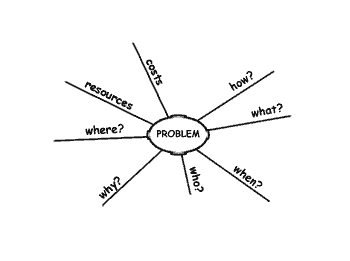
The first stage of a mind map with the first set of spokes labelled with the children's six questions and 'costs' and 'resources'.
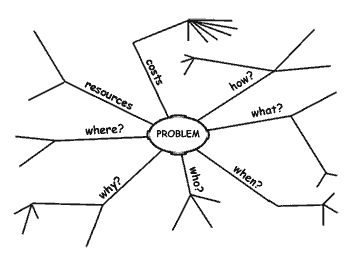
The second stage of a mind map with additional spokes labelled (not shown) with thoughts stimulated by the first set of labels. (These secondary labels are highly individual to the person drawing the mind map and are not shown.)
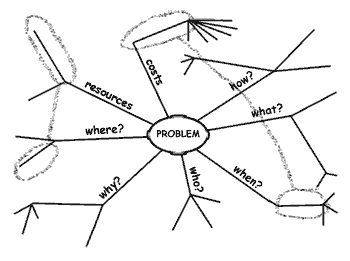
The last stage of a mind map with links between similar thoughts that have occurred on different spokes.
The diagrams show three stages in the production of a mind map. Its spokes are labelled with well-tried and tested routes to creativity in research. Six are the known as the 'children's questions': why? how? what? when? where? and who? The other two are 'costs' and 'resources' which have to be part of research planning. Resources are what one has at one's disposal which cost nothing, and costs involve an outlay of some sort, which are not necessarily financial.
To use a mind-map, you would:
- Write down what the problem or issue is inside the central blank box with labelled spokes
- Add more spokes if you think they would be useful.
- Let your mind wander over the questions or issues on each spoke and label keywords for your thoughts - any thoughts - on spoke-extensions. At this stage the mind map will look somewhat like that in the second diagram, with, of course, additional and highly personal labelling.
- Continue drawing more spoke-extensions and labelling them until you run out of ideas.
- Finally link any ideas that appear on more than one spoke, as shown in the third diagram.
By this time, you may feel that a viable solution to the problem has already occurred to you. If not, put the sketches aside and wait to see if a solution pops into your head later. If it doesn't after a few days, look at the mind map again and try to amend it in some way to set your mind pondering about the problem in this free and unconstrained way.
General information

More creative thinking techniques
For all the creative thinking techniques that can be useful in research, see the top of this page.
Creative thinking techniques on this website
The following pages give creative thinking techniques which can be useful in research:
© Pat Cryer
* 'Supervisor' is a shorthand for 'research degree supervisor', 'advisor' or 'tutor', and applies to varying extents for all research degrees: PhD, DPhil. MPhil, Prof Doc and even undergraduate and masters' projects. In some countries, notably the USA, a 'supervisor' is known as an 'advisor'.